
How to choose a custom embroidery company: a complete guide
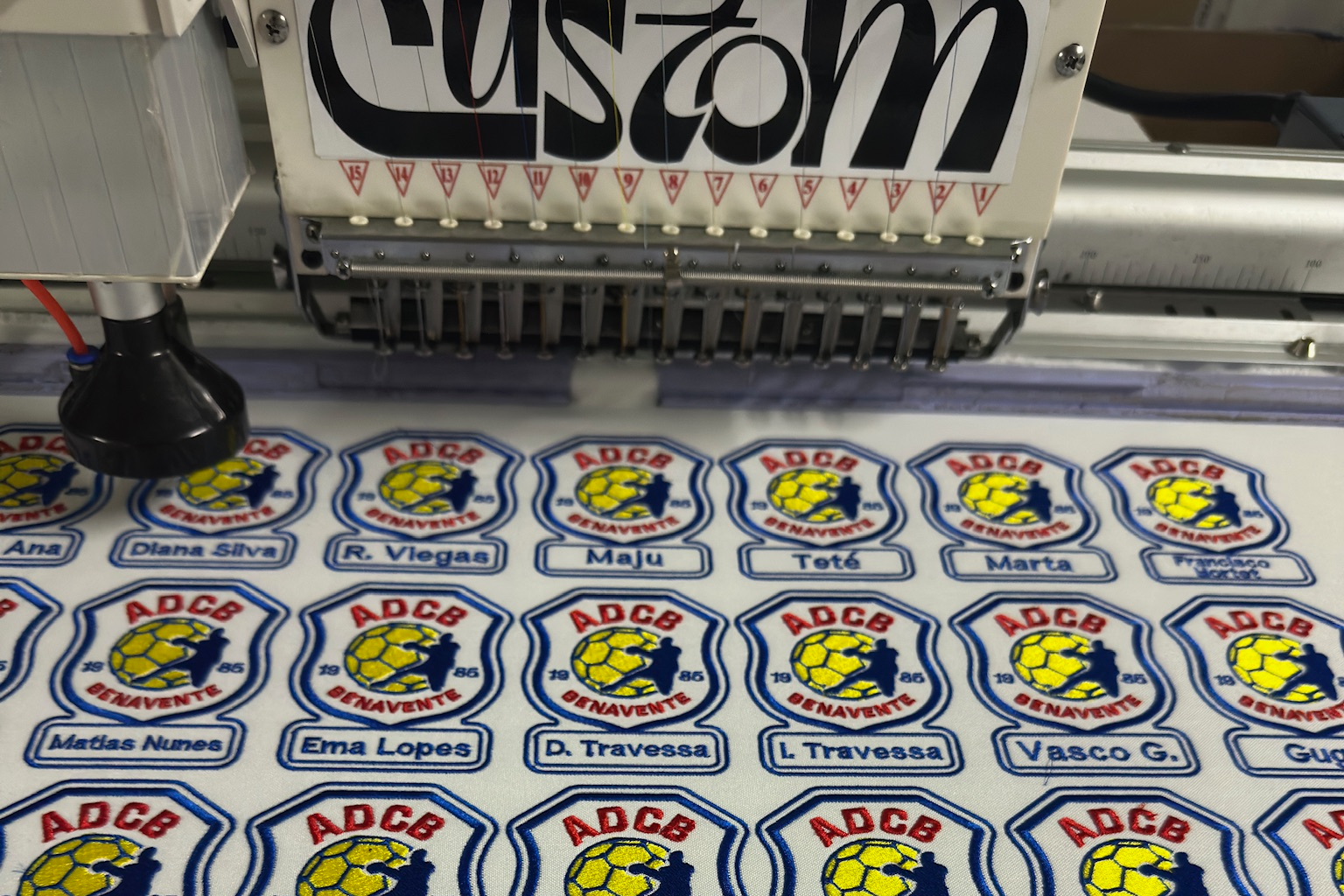
Choosing a custom embroidery company solely because it offers the lowest quote is one of the most common mistakes people make before placing an order. Price matters, but on its own it does not reveal the quality of the embroidery file, the accuracy of the final result, the materials used, the quantity that will actually be delivered, the consistency of the stated dimensions or the company's ability to handle technically demanding work.
Two proposals may look similar and still produce completely different results. In the same way, a more expensive company is not automatically better, and a more affordable company is not necessarily worse. Some businesses can offer competitive prices because of their scale, production organisation or fully depreciated equipment. The real challenge is understanding what is included, what level of quality has been demonstrated and whether the supplier has experience with the type of work you intend to order.
In this guide, we explain how to assess portfolios, photographs, mock-ups, materials, quotes, quantities, lead times and customer reviews before choosing a custom embroidery company.
To choose a custom embroidery company, do not compare prices alone. Look at genuine work similar to your project, compare the original artwork with the embroidered result, confirm the size of the personalisation, check what is included in the quote, read customer reviews and determine whether the company advises clients when a design, size or material is unsuitable.
Send us your artwork, quantities and the information you received. We can help you understand the proposed size, the most suitable technique and what you should confirm before proceeding.
Request an assessment on WhatsAppContents
- Why price should not be the only criterion
- Is a more expensive company automatically better?
- How to assess an embroidery portfolio
- Real photographs, mock-ups and generated images
- Always compare the original artwork with the result
- Simple work does not prove an ability to handle complex projects
- The machine brand and company size do not guarantee quality
- A good company should advise, not simply accept
- What to confirm in a quote
- Pay attention to production tolerances and delivered quantities
- Does the mock-up really match the stated dimensions?
- Has the embroidery been adapted to different garment sizes?
- Materials, garments and durability
- Low-cost merchandise and products designed to last
- Communication, lead times and reviews
- How to recognise well-executed embroidery
- Warning signs before ordering
- Checklist for comparing embroidery companies
- How we work at Bordados Custom
- Frequently asked questions
1. Why price should not be the only criterion
When a customer requests several quotes, it is natural to organise the proposals by price. The problem begins when the final figure becomes the only factor in the decision.
A quote does not automatically show:
- the quality of the embroidery file;
- the accuracy of the reproduction of the original logo;
- the legibility of small lettering;
- the quality of the garments and threads;
- the stability of the fabric after embroidery;
- the finish on the inside of the garment;
- experience with similar projects;
- the exact number of units that will be delivered;
- the consistency between the mock-up and the actual dimensions;
- the support provided when the design is unsuitable.
Choosing the lowest price may result in a good purchase, but it can also mean comparing proposals that are not equivalent. One may include a more durable garment, a manually prepared embroidery file, adapted dimensions and the full ordered quantity. Another may use more economical materials, apply a smaller personalisation than the mock-up suggests or include a tolerance that allows fewer units to be delivered.
Therefore, before asking only “how much does it cost?”, it is also important to ask “what exactly will I receive?”.
Comparing only the totals of two quotes without confirming the garment brand and model, the size of the personalisation, the guaranteed quantity, the finishes, shipping costs and taxes.
2. Is a more expensive company automatically better?
No. A higher price does not automatically guarantee better quality. Likewise, an affordable proposal does not necessarily mean inferior work.
A company may be able to offer competitive prices for several legitimate reasons:
- it produces large quantities and benefits from economies of scale;
- it purchases materials in volume;
- its equipment and premises have already been depreciated;
- it has organised production efficiently;
- it works directly, without intermediaries;
- it has specialised in that type of product.
A small company can also deliver excellent quality at competitive prices. In areas such as embroidery, screen printing and craft production, there are modest studios producing technically superior work to that of much larger operations.
Price should be assessed alongside the portfolio, materials, proposal terms, level of support and suitability for the project.
| Criterion | What it may indicate | What it does not prove on its own |
|---|---|---|
| Low price | Efficiency, scale, a promotion or more economical materials | That the work will be poor |
| High price | Better materials, greater complexity, more service or a different cost structure | That the result will be superior |
| Large company | Production capacity and organisation | That the embroidery file and finishing are high quality |
| Long-established company | Continuity and accumulated organisational experience | That the person currently responsible for the work is experienced |
3. How to assess an embroidery portfolio
A portfolio is one of the best tools for evaluating a company. However, it is not enough to check whether there are attractive photographs. You need to look for work that is relevant to your project.
If you want to embroider a large name on a sweatshirt, almost any company with suitable equipment should be able to show similar work. But if you need to reproduce a coat of arms, a detailed illustration, small lettering, a face, a complex patch or a small logo, you should look for specific evidence of that capability.
When assessing a portfolio, check whether:
- there are clear close-up photographs;
- the projects are real and not only mock-ups;
- there are examples with a similar level of difficulty to your project;
- small lettering remains legible;
- the outlines are aligned;
- the fabric lies flat without excessive puckering;
- important details have been preserved;
- the company shows different materials and products;
- the work shown is recent and consistent;
- the company is clearly proud to show the finished result.
A company that produces strong, technically demanding work has every reason to show it. These projects increase credibility and demonstrate abilities that a simple photograph of embroidered text cannot prove.
4. Real photographs, mock-ups and generated images
Today, it is easy to create very appealing images using renders, stock images or artificial intelligence. These images can be useful for presenting an idea, but they do not demonstrate that the company can physically produce that result.
A digital mock-up shows a prediction. A real photograph shows what happened when thread, needle, fabric, tension, stabiliser and machine all became part of the process.
When assessing a website or social media profile, try to distinguish between:
- a photograph of the real product: this allows you to evaluate texture, stitches, outlines and fabric behaviour;
- a digital mock-up: this helps communicate the intended appearance and placement, but does not prove execution;
- a generated or heavily manipulated image: this may depict a product that was never produced;
- a supplier's catalogue photograph: this shows the base product, not the quality of the company's personalisation.
A realistic embroidery simulation is useful for approval, but the definitive test always takes place on the material. Stitch direction, thread tension and the way the fabric reacts can change the appearance compared with what is shown on screen.
5. Always compare the original artwork with the result
Embroidery can look attractive when viewed on its own and still be very different from the artwork supplied by the customer.
Without seeing the original, it is impossible to determine whether:
- the proportions were respected;
- the lettering was altered;
- elements were moved;
- essential details disappeared;
- the visual style of the logo was preserved;
- the simplifications were technically justified;
- the result still conveys the original identity.
For this reason, one of the best signs in a portfolio is a side-by-side presentation of three elements:
- the artwork or logo received;
- the mock-up or technical adaptation;
- the finished embroidery.
The goal is not to expect thread to reproduce a digital file as though it were a print. Embroidery has physical limitations and its own visual language. However, a good adaptation should preserve what makes the design recognisable: its structure, hierarchy, shapes, contrast, lettering and main elements.
Embroidery should not be judged simply because it looks “nice”. It should be judged by the quality of the interpretation of the requested artwork.
6. Simple work does not prove an ability to handle complex projects
Names, numbers and large shapes are important in a portfolio, but they do not demonstrate all the skills required for complex work.
Before choosing a company, look for examples that are close to what you need:
- a small logo with text: check the legibility;
- a detailed patch: check the outlines, overlaps and definition;
- a realistic illustration: examine how shadows, volume and colours were interpreted;
- a monochrome design: see whether stitch direction and line thickness create depth;
- embroidery on a cap: look for work produced on curved surfaces;
- thin fabric: check whether the garment shows puckering;
- large embroidery: examine whether the result remains balanced and comfortable.
It is also important to maintain realistic expectations. Embroidery is not photographic printing. Some details may need to be adapted, and some lettering becomes impractical below certain dimensions. The difference lies in the company's ability to identify those limits and propose an effective solution.
7. The machine brand and company size do not guarantee quality
The question “what machine do you use?” may be relevant when discussing maximum dimensions, application types or production capacity. However, the machine brand alone is not a sufficient indicator of embroidery quality.
An industrial embroidery machine executes the instructions it receives. It does not decide by itself:
- how to simplify the design;
- what density is appropriate;
- which stitch type to use;
- how to compensate for fabric movement;
- which sequence will prevent misalignment;
- whether lettering will remain legible;
- whether the finished result will be comfortable.
These decisions depend on the embroidery file and on the people who prepare, operate and supervise production. A factory with many machines may have substantial capacity, but quality still depends on the team responsible for the specific project.
The same applies to how long the company has existed. An organisation may have been operating for decades while the person currently preparing its embroidery files has only recently started. Conversely, a newer professional can produce excellent results if they have knowledge, precision, practical experience and a willingness to improve.
Assess the work being demonstrated, not only the number of years, the building, the number of machines or the corporate appearance.
To understand the importance of technical preparation in greater detail, read our guide explaining what an embroidery file is and how it influences the finished result.
8. A good company should advise, not simply accept
A good company should not limit itself to saying “yes” to every request. It should understand how the product will be used, analyse the artwork and explain when a different solution would be more suitable.
That advice may include:
- increasing the size to preserve detail;
- simplifying elements that are too small;
- thickening lettering or lines;
- changing the embroidery position;
- choosing a more structured garment;
- adapting the density to the fabric;
- dividing the design across several areas;
- recommending printing or sublimation for photographs and very smooth gradients;
- advising against very dense embroidery on a garment that will be in direct contact with the skin.
Gradients, for example, can be interpreted through combinations of colours, densities and stitch directions. The result can be artistically appealing, but it will not necessarily have the perfectly smooth transition of a print. If the customer wants a photographic gradient, a printed solution may be more appropriate.
Being transparent does not mean refusing every difficult project. It means explaining the limitations, presenting alternatives and allowing the customer to make an informed choice.
9. What to confirm in a quote
A professional quote should make it possible to understand what is being purchased. Not every company presents information in the same way, but there are several points the customer should confirm before paying.
| Item | What to confirm | Why it matters |
|---|---|---|
| Product | Brand, model, composition, colour and sizes | Garments that look similar can differ significantly in quality and fit |
| Quantity | The number ordered and the minimum guaranteed number | Some proposals allow for a production shortage |
| Personalisation | Technique, position, number of areas and approximate dimensions | A large image in the mock-up may correspond to a much smaller application |
| Embroidery file | Whether there is a digitising fee, whether it is included and what the conditions are | This prevents unexpected charges and uncertainty about repeat orders |
| Finish | Sew-on, heat-seal adhesive, hook-and-loop backing or inner finishing | The same embroidery can have different applications and costs |
| Lead time | Estimated timing, any critical date and the conditions that may affect it | This prevents an estimate from being mistaken for an absolute guarantee |
| Final price | VAT, shipping, preparation and extras | This makes it possible to compare equivalent totals |
| Approval | Whether a digital mock-up, validation or physical test will be provided when required | This reduces differences between expectations and the finished result |
10. Pay attention to production tolerances and delivered quantities
Problems can occur during textile production: a needle may break, a garment may arrive defective from the supplier, a print may fail or fabric may be damaged during personalisation. Some companies include a production tolerance in their contracts to account for these losses.
This means that an order for 100 units may permit the delivery of 97, 95 or another number, depending on the percentage stated in the terms. On an order of 1,000 units, a 7% tolerance could represent as many as 70 missing items.
Such a margin is not necessarily hidden or unlawful when it is clearly stated and accepted. However, the customer should understand its practical effect before comparing that price with a proposal that guarantees the full quantity.
Always ask:
- Is the stated quantity guaranteed?
- Is there a positive or negative tolerance?
- Are missing items deducted from the price?
- Can additional safety units be produced?
- Does the event or team require that exact number?
Do not assume that “100 units” necessarily means 100 units will be delivered. Read the terms and confirm the minimum guaranteed quantity in writing.
11. Does the mock-up really match the stated dimensions?
A mock-up can create a misleading impression when the personalisation is shown out of scale.
Imagine a tote bag approximately 40 cm high. In the image included with the quote, the design appears to cover almost the entire front. However, the specifications state that the print will be only 30 × 25 cm. The finished product will have a much larger margin than the mock-up suggests.
The problem becomes even more obvious when the proportions do not match. If the original design is square but the area stated in the quote is clearly rectangular, it is necessary to understand whether the design will be distorted, cropped, reduced or simply placed with different margins.
To check consistency:
- confirm the product dimensions;
- confirm the personalisation dimensions;
- compare the proportions of the artwork;
- estimate the remaining margin;
- request a scale mock-up when placement is important.
A mock-up is a communication tool. It should bring expectations closer to the finished result, not create a visual impression that is incompatible with the contracted dimensions.
12. Has the embroidery been adapted to different garment sizes?
With small chest embroidery, it is common to use the same dimensions across several garment sizes. A logo measuring 8 or 9 cm may remain proportionally suitable from size S to XXL.
The situation is different with large designs on the back, across the full chest or in other broad areas. Embroidery measuring 30 cm wide may look balanced on a large jacket but oversized on a smaller or women's garment.
A good company should assess:
- the actual width of each garment;
- whether the cut is men's, women's, children's or unisex;
- the clearance from seams;
- the visual placement on each size;
- whether more than one size of embroidery file is required;
- the effect of the embroidery on comfort.
It is not always necessary to change the size, but the decision should be deliberate. Automatically repeating the same personalisation on every garment can produce unbalanced results.
For more detail, read our guide on how to choose the right embroidery size for different garments.
13. Materials, garments and durability
Embroidery is often presented as a premium and durable personalisation technique. However, the durability of the finished product depends on the full combination of garment, thread, needle, embroidery file, stabiliser, tension, finishing and care.
A company may reduce costs by using:
- garments with lower stability after washing;
- threads with lower abrasion resistance;
- colours with lower resistance to washing and light;
- unsuitable stabilisers;
- less time for finishing;
- garments designed for short-term promotional use.
This does not mean that every economical product is poor. A T-shirt for a one-day event has different requirements from a uniform worn and washed several times a week. What matters is that the product is suitable for its intended use and that the customer understands what they are choosing.
At Bordados Custom, we prioritise high-quality embroidery threads and, whenever the colour and application allow, use options made from 100% recycled material. The environmental choice does not reduce our technical standards: the thread must still provide strength, colour stability and reliable performance during production.
We also assess garments before recommending them. Fabric weight alone does not guarantee quality. The knit construction, fibres, seams, fit and stability after washing are equally important. You can explore this subject further in our guide to choosing quality garments for embroidery.
14. Low-cost merchandise and products designed to last
Not every personalisation company has the same market position. Some work mainly with promotional gifts and low-cost merchandise, where the primary objective is to produce large quantities for campaigns, events or giveaways.
That model may be appropriate when the product will only be used for a short period. The problem arises when a customer believes they are buying everyday clothing or a durable product but receives something designed for a temporary promotion.
Before choosing, explain how the product will be used:
- Will it be worn only once?
- Will it be washed every week?
- Is it professional workwear?
- Will it be sold as a branded product?
- Is it a promotional giveaway?
- Does it need to withstand abrasion, sunlight, rain or industrial washing?
A good company should adapt its proposal to the product's actual use. The cheapest option may be the correct choice for a short campaign. For workwear, hospitality, catering, industry, motorcycle clubs or clothing brands, a higher-quality garment and better materials are often more economical over time.
15. Communication, lead times and reviews
A company's work does not end when the customer approves the mock-up. Communication throughout production is also part of the service.
A transparent company should be able to:
- confirm that payment and files have been received;
- explain which stage the order has reached;
- answer reasonable questions;
- notify the customer when a significant delay occurs;
- distinguish an estimate from an absolutely guaranteed date;
- present a solution when a problem occurs.
Textile production depends on suppliers, carriers, the availability of colours and garments, and functioning equipment. Unexpected issues can occur. The problem is not simply that a delay exists; it is repeatedly promising one week and delivering two months later without communication.
Before ordering, check:
- reviews on Facebook or other available platforms;
- customer comments;
- photographs in which the company has been tagged;
- posts and stories shared by buyers;
- repeated complaints about delays, quality or lack of response;
- how the company responds when criticism is made.
A single review does not define a company. Look for patterns. Many consistent opinions over time are more useful than one exceptionally positive or negative comment.
16. How to recognise well-executed embroidery
A photograph cannot reveal everything, but there are several important visual signs.
Legible lettering
Letters should remain recognisable within the physical limits of the chosen size. Small text requires careful adaptation, spacing and stitch selection.
Consistent outlines
Outlines should follow the shapes without excessive misalignment. Small variations can occur because of fabric movement, but good preparation reduces this effect.
Stable fabric
The material should not show pronounced puckering, rippling or holes caused by excessive density, inadequate stabilisation or incorrect tension.
Balanced coverage
The background should not show through in areas intended to have full coverage. At the same time, the embroidery should not be so dense that it becomes unnecessarily rigid.
Preserved details
The important elements of the artwork should remain identifiable. When simplification is necessary, it should respect the visual hierarchy of the design.
Clean finishing
Check for loose threads, excess stabiliser, harsh trimming and rough ends on the inside. Good finishing improves appearance, comfort and durability.
Consistency between units
Within a production run, the garments should maintain consistent placement, colours and dimensions within the normal tolerances of the process.
17. Warning signs before ordering
- The company does not show any real work.
- The portfolio contains only mock-ups, catalogue images or generated images.
- There are no projects similar to the one you require.
- The company promises to reproduce every detail at any size without analysing the artwork.
- The dimensions shown in the mock-up do not match the specifications.
- The quote does not identify the product or the size of the personalisation.
- Additional charges only appear at the end.
- The quantity delivered may be lower, but the allowed margin is not explained.
- The supplier avoids answering questions about materials, finishes or lead times.
- There are repeated complaints about delays far beyond what was promised.
- Price is used as the only evidence of quality.
- The machine brand or factory size replaces any genuine demonstration of work.
“The most expensive company is the best.” Price is not a substitute for evidence of quality.
“A large factory always produces better work.” Production capacity does not guarantee the quality of the embroidery file or finishing.
“Because it is embroidered, it will last regardless of the materials.” The garment, thread, stabilisation and execution also determine durability.
18. Checklist for comparing custom embroidery companies
Portfolio
□ I have seen real photographs of completed work.
□ I found examples with a similar level of difficulty to my project.
□ Where possible, I compared the original artwork with the finished embroidery.
□ The lettering, outlines and details appear consistent.
Quote
□ I know the brand and model of the product.
□ I know the size and position of the personalisation.
□ I confirmed the minimum quantity that will actually be delivered.
□ I confirmed the embroidery file, finishes, VAT, shipping and extras.
□ The mock-up is consistent with the stated dimensions.
Service
□ The company analysed the artwork and advised me when necessary.
□ The lead time was explained as either an estimate or a clear commitment.
□ There are verifiable reviews or references.
□ I know how the company will respond if a problem occurs.
Suitability
□ The product is suitable for the expected frequency of use and washing.
□ The embroidery size makes sense for the selected garments.
□ I am not making the decision based on price alone.
19. How we work at Bordados Custom
At Bordados Custom, we manage the preparation of the embroidery file, material selection, production and finishing in-house. Our aim is to take responsibility for the complete process rather than separating the technical preparation from the finished result.
We analyse the artwork before production
We assess the level of detail, size, product, position and intended use. When an option is unsuitable, we explain the problem and present alternatives. The customer retains the final decision, but can proceed with realistic expectations.
We show how the artwork has been adapted
We provide a digital mock-up so the customer can understand how the design has been interpreted. For new or complex projects, or when the selected material justifies it, tests and corrections may be carried out before final production.
We do not charge a separate embroidery digitising fee
The technical preparation time is naturally part of our pricing structure, but we do not add a separate and unexpected charge simply to prepare the artwork. The customer receives a price for the finished product.
We guarantee the ordered quantity
When a customer orders 100 units, our contractual objective is to deliver 100 units. We do not use a production-loss tolerance to reduce the promised quantity. Whenever an exceptional situation occurs, we communicate it and seek a solution before considering the order complete.
We select quality materials
We use threads, needles and stabilisers suited to each project. Whenever possible, we choose threads made from 100% recycled material without compromising technical performance. We also avoid recommending garments that, in our experience, repeatedly present construction, stability or durability problems.
We retain the production history for repeat orders
Embroidery files and production information are stored in our systems. This allows us to repeat projects, preserve dimensions and closely match thread colour references when a customer orders again.
We do not want to win an order through a misleading visual promise or a price that does not correspond to the finished product. We prefer to explain the limitations, present the available options and produce a solution suited to its real intended use.
20. Frequently asked questions about choosing an embroidery company
Should I choose the cheapest quote?
You should not reject a proposal simply because it is affordable, but you should not choose it based on price alone either. Confirm that the products, dimensions, quantities, finishes, materials and conditions are equivalent.
Does a more expensive company necessarily produce better work?
No. The price may reflect materials, structure, service, complexity or commercial margin, but quality should be assessed through real work and clearly stated conditions.
How can I tell whether portfolio photographs are genuine?
Look for thread texture, small natural variations, different angles, production photographs and posts shared or tagged by customers. Mock-ups and generated images can be useful, but they should be supported by physical results.
What should I look for in small embroidery?
Check the legibility of the lettering, the separation between elements, the outlines, coverage and fabric stability. Look for examples produced at a size similar to the one you require.
Is the machine brand important?
It may be relevant to capacity, dimensions and specific functions, but it does not guarantee quality. The embroidery file, materials, preparation and operator experience are decisive.
Is it normal for a company to charge for the embroidery file?
Yes. Creating an embroidery file requires time and specialist knowledge. Some companies charge for it separately, while others include the work in the final price. What matters is understanding the conditions before accepting the quote.
Can the full ordered quantity fail to be delivered?
Some proposals include production tolerances. Confirm the minimum guaranteed number in writing and what happens when units are missing.
How do I confirm whether a mock-up is to scale?
Compare the product dimensions with the stated dimensions of the personalisation. Also check whether the proportions of the artwork match the area shown.
Can the same embroidery size be used on every garment size?
It may work for small logos. With large personalisations, the dimensions may need to be adapted to different cuts and sizes to maintain balanced proportions.
Which reviews should I look for?
Look for patterns across reviews, comments, customer photographs and complaints. Pay particular attention to repeated references to quality, communication, lead times and problem resolution.
Should a company refuse a difficult project?
It should at least explain when the artwork, size or material will not allow the expected result. It may suggest changes, increase the dimensions or recommend another technique. Accepting the work without any analysis is not necessarily a good sign.
What information should I provide to receive a comparable quote?
Send the artwork, required product, quantity, sizes, approximate dimensions, position, intended use and deadline. The more complete the information, the easier it will be to compare equivalent proposals.
Conclusion
Choosing a custom embroidery company requires more than arranging quotes from the cheapest to the most expensive.
Price remains important, but it should be considered together with the portfolio, fidelity to the original artwork, dimensions, materials, quantities, lead times, customer reviews and the company's ability to advise.
Look for real work similar to your project. Confirm that the mock-up matches the specifications. Read the production terms. Ask what is included. Check whether the company demonstrates experience with technically demanding projects and whether it is willing to explain when an idea needs to be adapted.
Sometimes, the best way to save money is not to choose the lowest proposal. It is to avoid paying two or three times before finding a company you can trust.
A good supplier is not necessarily the largest, the oldest or the most expensive. It is the one that demonstrates it can execute your project, clearly explains what will be delivered and takes responsibility for the result.
Send us your logo, artwork or idea, tell us the quantity and explain where you would like the embroidery applied. The Bordados Custom team will assess the project and recommend the most suitable size, product and solution, with no mandatory minimum order and no separate embroidery digitising fee.
Request a quote on WhatsApp