
Embroidery Size Guide: How to Choose the Right Size for Each Type of Garment
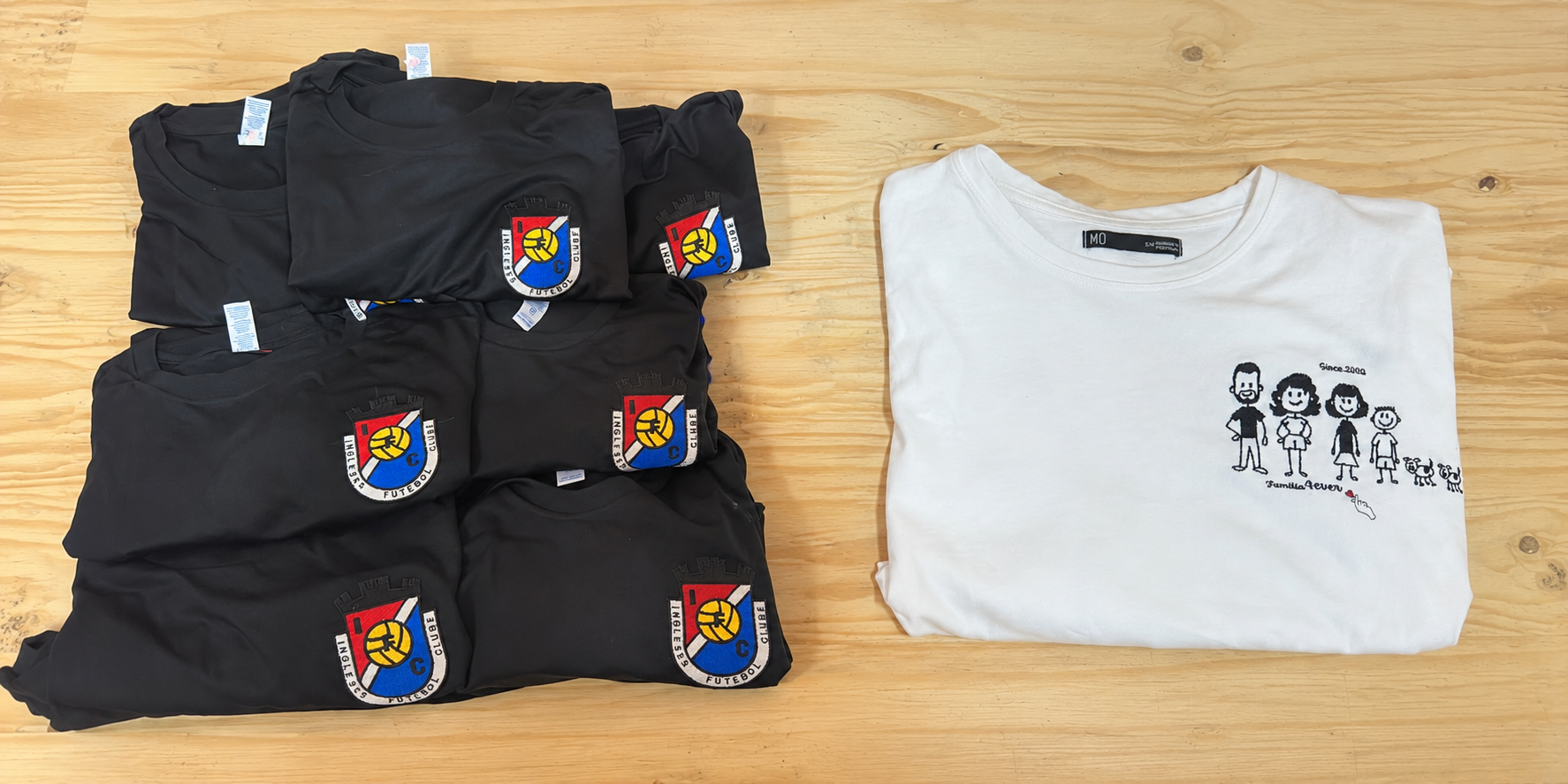
Choosing the right embroidery size is one of the most important steps to achieve a clean, balanced, comfortable and durable result. When a customer orders custom embroidery, one of the first questions is usually simple: “What size should the embroidery be?”
The answer depends on several factors: the type of garment, the placement of the embroidery, the shape of the design, the amount of detail, the fabric and even how the item will be worn or used.
At Bordados Custom, we work with many different types of items, from t-shirts, polos and hoodies to caps, aprons, towels, jackets, vests and backpacks. That is why we know there is no single universal size that works for every embroidery project.
A 10 cm embroidery may look perfect on one item and too large on another. In the same way, a 20 cm embroidery can still be considered small if it is very horizontal and has a low height. The most important thing is not to look only at a measurement in centimetres, but to consider the total embroidered area and the shape of the design.
Send us your logo, design or image and tell us which item you want to customise. Our team will analyse the shape, level of detail and placement area to recommend a balanced, comfortable and technically suitable embroidery size.
Ask for help on WhatsAppBefore discussing the recommended embroidery sizes for each type of item, it is important to make one essential distinction: embroidering finished garments is not the same as embroidering fabric or panels before the item is manufactured.
Embroidering Finished Garments vs Embroidering Before Manufacturing
When we talk about custom embroidery, there are two main ways to work: embroidering an item that is already finished, or embroidering the fabric before the item is sewn and completed.
Most custom embroidery requests involve finished items, such as t-shirts, polos, hoodies, caps, aprons, towels, jackets, vests or backpacks. In these cases, the embroidery is applied directly to the final product.
This option is practical and works well for many projects, but it also has technical limitations. Since the item is already assembled, we need to work around the existing structure: seams, pockets, curves, sleeves, narrow areas, different fabric thicknesses and areas with limited machine access.
For that reason, when embroidering finished garments, the size and position of the embroidery always depend on the available area and on how the item can be correctly placed in the embroidery machine.
For example, on a t-shirt or polo shirt, a large back embroidery may make the garment heavier and less comfortable. On a cap, there is a clear height limitation. On a sleeve, the available width is smaller. On a finished backpack, we can usually only embroider flat and accessible areas, such as the front panel or front pockets.
In other words, it is possible to achieve excellent results on finished garments, but we always need to respect the physical limitations of the item.
On the other hand, when embroidery is done before manufacturing, there is much more freedom. In this case, we are not embroidering a finished item, but the raw material that will be used to create the final product: fabric, panels, parts of a backpack, parts of a cap, garment sections or other loose components.
Whenever this option is possible, it is usually the best solution both for the embroidery team and for the customer. This is because the fabric is still flat, accessible and free from the limitations created by seams, pockets or the final shape of the product.
Embroidering before manufacturing makes it easier to achieve better embroidery centring, greater size flexibility, improved access to the working area, more accurate positioning, fewer limitations in difficult areas and a final finish that is planned from the very beginning of the product.
This approach is especially useful for made-from-scratch productions, such as backpacks, caps, uniforms, technical garments, personalised accessories or clothing created by seamstresses, brands or manufacturers.
In addition to creative and technical freedom, there is also an important production advantage. In any embroidery job, especially in larger productions, there can be a small margin of loss due to factors such as broken needles, production errors, machine faults, design issues, maintenance stops or unexpected technical problems during the process.
When embroidering finished garments, any error can mean losing the complete final item. This means not only losing the fabric, but also all the time and work that has already gone into cutting, sewing and finishing that product.
When embroidery is done directly on the raw material before the item is sewn, a possible mistake only affects that specific piece of fabric or panel. This helps reduce the waste of time, labour and finished products.
For this reason, in larger productions, it is normal to consider a margin of loss. When working with finished garments, there may be an approximate loss of around 1%, depending on the type of project, embroidery complexity, material and production quantity.
This margin does not mean poor quality. It is a normal reality in textile and embroidery production, where machines, threads, needles, fabrics and several technical factors are involved.
That is why, when the customer has the possibility to plan the embroidery before the item is manufactured, that is usually the best moment to define everything: size, placement, quantity, thread type, application area and final finish.
In short: embroidering finished garments is ideal for direct personalisation and ready-to-produce orders; embroidering before manufacturing is the best option when the item is being created from scratch and the goal is greater freedom, precision and production efficiency.
Embroidery Size Is Not Just About Centimetres
When people talk about embroidery size, they often think only about width or height. However, that way of measuring can be misleading.
For example, an embroidery design that is 20 cm wide and only 2 cm high may be considered small in terms of total area. It is a long, low and visually light design. On the other hand, an embroidery design that is 15 cm wide and 15 cm high takes up much more space and can feel quite large, both visually and on the fabric itself.
That is why, when choosing an embroidery size, it is essential to consider the width, height, total occupied area, shape of the logo or image, stitch count, fabric type and the garment area where the embroidery will be applied.
In practice, when we refer to a measurement such as “15 cm”, we are usually talking about the largest dimension of the design. If the design is horizontal, that measurement usually refers to the width. If the design is vertical, it may refer to the height. If it is round or square, width and height will be similar.
This difference is very important to avoid mistakes. A horizontal logo with a width of 15 cm can look discreet and elegant. A round badge with a width and height of 15 cm can be too large for a chest placement.
Embroidery Size for T-Shirts
T-shirts are one of the most common garments for personalisation, but they also require some care. Because they are usually made from lighter fabric, embroidery should not be chosen based only on visual impact. It is also important to consider comfort and the weight that the embroidery will add to the garment.
On t-shirts, the most recommended embroidery placements are the left chest, right chest, centre chest and small applications in specific areas.
For chest embroidery, it is common to work with sizes up to around 15 cm, depending greatly on the shape of the design. However, for logos with similar width and height proportions, such as round badges, shields or compact symbols, the most commonly used sizes are usually between 8 and 10 cm.
A round logo with an 8 cm size can look balanced on a t-shirt. A 10 cm round logo already has more presence. A 15 cm round logo may look visually oversized, because it occupies 15 cm in width and 15 cm in height.
For horizontal logos, the situation is different. An embroidery design with a width of 15 or even 20 cm can work well if it has a low height, for example 5, 6 or 7 cm. Since the total embroidered area is smaller, the embroidery does not feel as heavy or visually excessive.
Large Embroidery on T-Shirts
Although it is technically possible to embroider larger areas on t-shirts, it is not always the most comfortable option. Large embroidery can make the garment stiffer, heavier and less pleasant to wear, especially when placed in areas that are in direct contact with the body.
For this reason, on t-shirts, we usually recommend more controlled and well-positioned embroidery. The goal should always be to achieve a clean, professional and comfortable final result.
Back embroidery on t-shirts is not as common when we are talking about large areas or very dense logos. It can make the garment heavier and change the natural feel of the fabric. Even so, there are situations where it makes sense, especially for lettering, names, team identification, “staff” text or horizontal logos with low height.
In these cases, it is important to make sure the t-shirt has enough quality to support the embroidery. At Bordados Custom, we work with suitable garments for this type of personalisation, helping to avoid fragile or uncomfortable results.
Embroidery Size for Polo Shirts
Polo shirts are an excellent option for custom embroidery, especially for professional use, companies, restaurants, events, teams, shops and workwear.
Just like with t-shirts, the most common placement is the chest, usually on the left or right side. For chest logos, the most commonly used sizes are usually between 8 and 12 cm, depending on the shape of the design.
A simple logo with good readability and balanced proportions can work very well at this size. If the design is horizontal, it can be wider, as long as the height remains proportional and comfortable.
On polo shirts, it is also important to check whether there is a chest pocket. When the polo has a pocket, the embroidery can sometimes be placed on the pocket itself or above it, depending on the available space. However, if the pocket is too small or narrow, there may not be enough room to embroider with quality.
As with t-shirts, large back embroidery is not very common on polo shirts. Still, it is possible to embroider names, job titles, lettering, staff identification or horizontal logos with a controlled embroidered area.
The quality of the polo shirt is also essential. A polo with a more structured fabric will support the embroidery better and maintain a more professional appearance after personalisation.
Embroidery Size for Sweatshirts and Hoodies
Sweatshirts and hoodies offer much more freedom than t-shirts or polos. They are thicker, more resistant garments and are usually not in such direct contact with the skin. For that reason, they support larger and denser embroidery much better.
On this type of garment, it is possible to embroider on the left or right chest, centre chest, back, sleeves, hood, front pocket when technically possible and small decorative areas.
On hoodies and sweatshirts, the embroidery size can vary a lot. It can be a small chest logo, a larger central design, a large back embroidery or even a combination of several embroidered areas on the same garment.
Unlike t-shirts, where the weight of the embroidery needs to be considered more carefully, sweatshirts allow much more freedom to create strong, visual and highly personalised pieces.
Sleeve Embroidery
The main limitation on sweatshirts and hoodies is usually the sleeves. A sleeve is a narrower area and does not always allow wide embroidery.
In many cases, the recommended maximum width for sleeve embroidery is around 6 to 7 cm, depending on the design, garment size and cut of the sweatshirt.
On a small sweatshirt, the sleeve will naturally be narrower. On an oversized garment or larger sizes, the sleeve may allow more generous embroidery. That is why each case should be evaluated according to the specific garment and the intended design.
Embroidery on the Front Pocket
On hoodies with a front pocket, embroidery may also be possible, as long as there is enough flat area and the position allows the garment to be properly secured for embroidery. When the pocket is too tight, small or difficult to access, embroidery may not be technically possible.
This rule also applies to other items with pockets, such as polo shirts with chest pockets, aprons with pockets or jackets with pocket areas.
Embroidery Size for Caps
Caps have their own rules. Unlike a t-shirt or sweatshirt, where there is a flatter and wider area, a cap has a curved structure and a clear height limitation.
On caps, the designs that usually work best are more horizontal, meaning designs that are wider than they are tall. This is because the biggest limitation for cap embroidery is the available height.
In general, it is possible to embroider up to around 7 cm in height, and in some cases close to 8 cm, depending on the cap model. Above that, the embroidery starts to get too close to the top of the crown, which can make the application difficult or even impossible.
The width, on the other hand, is usually more flexible, as long as the design adapts well to the front of the cap. A horizontal logo, a short phrase, a word or a wide and low symbol usually works better than a very tall badge.
The Type of Cap Affects the Embroidery Size
Not all caps offer the same available embroidery area. A lower-profile cap, which does not sit as deeply on the head, will have less useful height for embroidery. A larger cap, such as some trucker cap models, may offer a more generous front area.
That is why, before defining the final embroidery size, it is important to look at the cap model and understand whether the design fits well within the structure of the item.
Embroidery Size for Aprons
Aprons are very versatile items for custom embroidery. They are widely used in restaurants, bakeries, cafés, barbershops, shops, events, craft brands and work uniforms.
On aprons, it is possible to embroider on the chest, centre area, pockets, lower section or other areas, depending on the model.
If it is a small chest logo, the sizes can be similar to those used on t-shirts and polo shirts, usually between 8 and 12 cm. If it is a central logo, it can be around 15 cm or more, depending on the shape and the desired visual impact.
On aprons, size is not as limited as on t-shirts, because the item is usually not as fitted to the body and the fabric is often more resistant. For this reason, both small and larger embroidery can work well.
It is also possible to embroider on pockets, as long as they are large enough and allow proper application. If the pocket is too narrow or tight, embroidery may not be viable.
Embroidery Size for Towels
Towels allow a lot of freedom in terms of size and placement. They can be embroidered at the top, bottom, centre or in a specific area, depending on the goal.
The most common embroidery options on towels include names, initials, logos, monograms, decorative designs, embroidery for hotels, accommodation, spas or personalised gifts.
In many cases, logos or names of around 10 to 15 cm work very well, always depending on the shape. A long name may have more width and low height. A compact logo may need a smaller size to avoid looking oversized.
On larger towels, such as bath towels or beach towels, it is possible to use more generous embroidery sizes. On face towels or smaller items, the size should be adjusted to the available area.
The most important thing is to make sure the embroidery is proportional to the towel and that the chosen placement makes sense for how the item will be used. For example, on some towels, embroidery near the lower edge can look more elegant and practical than in the centre.
Embroidery Size for Jackets and Vests
Jackets and vests are excellent items for custom embroidery, especially for professional use, teams, companies, events, workwear, clubs and brands.
In terms of size flexibility, they are similar to sweatshirts. Because they are usually more structured and resistant, they allow small, medium or large embroidery, depending on the goal.
The most common placements are left chest, right chest, back, sleeve, collar or specific areas depending on the model.
For chest embroidery, it is common to use sizes similar to polo shirts, such as 8 to 12 cm, but this always depends on the shape of the logo. On the back, larger dimensions can be used, especially if the fabric has enough structure.
As with sweatshirts, sleeves have more limitations because they are narrow areas. The available width depends on the garment size, cut and type of jacket.
On vests, it is very common to apply logos on the chest and, in some cases, on the back. For companies and teams, this is a very effective solution because the embroidery is visible, durable and professional-looking.
Embroidery Size for Backpacks
Backpacks can also be embroidered, but it is important to consider how the item is constructed. When working with finished backpacks, it is usually only possible to embroider flat and accessible areas.
The most common areas are the front of the backpack, front pockets, flat panels and areas with enough access for the embroidery machine.
Normally, it is not possible to embroider straps, very curved areas, very rigid sections or hard-to-reach parts when the backpack is already manufactured.
If the goal is to embroider straps, specific panels or areas that become difficult to access after assembly, the ideal solution is to embroider before the item is sewn. This applies not only to backpacks, but also to caps, bags, technical items and made-from-scratch products.
How to Choose the Right Embroidery Size
To choose the right embroidery size, it is not enough to say “I want a 15 cm embroidery”. The design and the item need to be analysed together.
1. The Shape of the Design
A round, square or shield-shaped logo occupies more area than a horizontal logo with the same width. For this reason, two embroidery designs described as “15 cm” can have completely different visual impacts.
2. The Placement on the Item
A chest embroidery should not follow the same size logic as a back embroidery. A cap has a height limitation. A sleeve has a width limitation. A towel allows more freedom. Each area has its own rules.
3. The Type of Fabric
Lightweight fabrics, such as many t-shirts, require more care. Thicker fabrics, such as sweatshirts, jackets and vests, support larger embroidery more easily.
4. Comfort
A very large embroidery may look visually impressive, but it may not be comfortable to wear. This is especially important for garments that are in direct contact with the body.
5. The Amount of Detail
Designs with many details may need to be larger to remain readable. On the other hand, simple designs can work well in smaller sizes.
6. The Purpose of the Item
A professional garment may require a more discreet and elegant embroidery. A promotional, artistic or personalised piece may allow something larger and more eye-catching.
Frequently Asked Questions About Embroidery Sizes
What is the ideal size for chest embroidery?
For t-shirts, polo shirts, jackets and vests, chest embroidery usually works well between 8 and 12 cm, depending on the shape of the logo. For very horizontal designs, it may make sense to use wider measurements, as long as the height remains proportional.
Can I make large embroidery on a t-shirt?
Yes, it is possible, but it is not always recommended. Large embroidery on t-shirts can make the garment heavier and less comfortable, especially if the fabric is lightweight. For t-shirts, we usually recommend more controlled and well-positioned embroidery.
What is the maximum embroidery size for a cap?
The main limitation on a cap is height. In many cases, embroidery can be up to around 7 cm high, and in some models close to 8 cm. The width is more flexible, but it depends on the design and the type of cap.
Can you embroider on the back of garments?
Yes. On sweatshirts, hoodies, jackets and vests, back embroidery is quite common. On t-shirts and polo shirts, it is possible, but it should be evaluated more carefully to avoid making the garment too heavy or uncomfortable.
Can you embroider on pockets?
Yes, as long as the pocket is large enough and accessible for embroidery. This can apply to aprons, polo shirts with pockets, hoodies with front pockets, jackets and other garments. If the pocket is too small or tight, embroidery may not be possible.
Can towels have large embroidery?
Yes. Towels allow a lot of freedom, especially bath towels or beach towels. Even so, the size should be chosen according to the towel area, the shape of the design and the desired final result.
Is it better to embroider before or after the item is manufactured?
It depends on the type of project. For standard personalisation on ready-made items, embroidering after manufacturing is the most common option. However, when the item is being made from scratch, embroidering before manufacturing offers more freedom, better positioning and less waste in case of production errors.
Conclusion
The ideal embroidery size always depends on the item, the chosen placement, the shape of the design and the total area that the embroidery will occupy. There is no single measurement that works for every case.
A small embroidery can look elegant and professional. A larger embroidery can create impact and highlight a brand. The key is finding the right balance between aesthetics, comfort, durability and technical feasibility.
At Bordados Custom, we help you choose the most suitable embroidery size for each item, whether it is a t-shirt, polo shirt, hoodie, cap, apron, towel, jacket, vest or backpack.
If you have a logo, design, name or idea to embroider, send us the image and tell us which item you want to customise. Our team will analyse the shape, placement and type of product to recommend the best possible size.
This way, we make sure your custom embroidery is well-positioned, proportional, durable and finished with a professional result.
To avoid embroidery that is too small, too large or uncomfortable, send us the image you want to embroider and tell us the type of item: t-shirt, polo shirt, cap, hoodie, apron, towel, jacket, vest or backpack.
Our team will review your project and help you choose a size that is proportional, readable and suitable for the material and placement area.
Send image on WhatsApp
